An acne cream ranking needs more than an ingredient percentage and a favorable study conclusion. In a randomized trial involving 37 volunteers, a cream combining chloroxylenol 0.5% with salicylic acid 2% was compared with benzoyl peroxide 5% gel over 12 weeks. Both groups had substantial reported reductions in inflammatory and noninflammatory lesions. The combination also had favorable findings for two adverse effects at the final visit. Those results make the formulation worth discussing, but they do not establish a category-wide winner.
The central question is what was actually tested: two complete formulations, not salicylic acid and benzoyl peroxide in isolation. This analysis uses the indexed primary report abstracts and available official FDA material; it does not claim review of all full texts, protocols, or supplements. Read together, the studies help distinguish evidence for a particular cream, evidence for adding an ingredient to a regimen, and evidence that is too limited to support a confident product ranking.
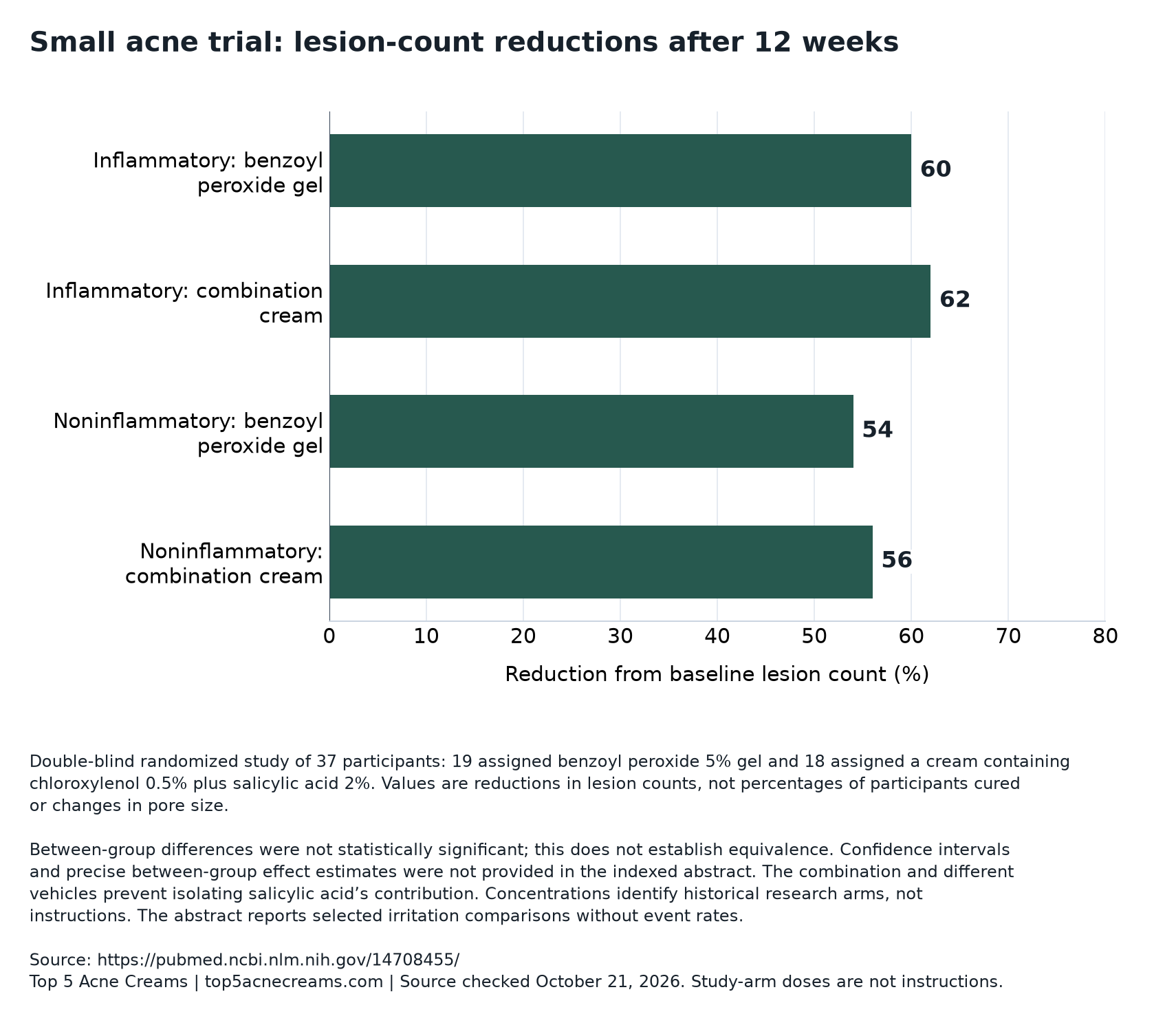
Study facts at a glance
- Trial design: The randomized, double-blind comparison lasted 12 weeks and included 19 volunteers assigned to benzoyl peroxide gel and 18 to the chloroxylenol–salicylic acid cream. [1]
- Lesion-count findings: Reported inflammatory lesion reductions were 60% with benzoyl peroxide and 62% with the combination; noninflammatory reductions were 54% and 56%, respectively. [1]
- Statistical interpretation: Between-group lesion reductions were not statistically significantly different. That finding does not establish formal equivalence. [1]
- Tolerability signal: Erythema and photosensitivity were reported less often with the combination at week 12, but the abstract does not provide event frequencies or absolute risk differences. [1]
- Regulatory distinction: FDA’s OTC acne monograph lists salicylic acid at 0.5–2% and benzoyl peroxide at 2.5–10%; those ranges are not product-specific approvals. [2]
The trial compared complete treatments, not isolated ingredients
The main study was a 12-week, double-blind randomized comparison of two topical facial acne treatments. Nineteen volunteers received benzoyl peroxide 5% gel, while 18 received chloroxylenol 0.5% plus salicylic acid 2% cream. Participants applied their assigned medication to the entire face twice daily. That schedule describes the research intervention, not a recommendation for readers.
Clinical assessments and lesion counts occurred at baseline and weeks 3, 6, 9, and 12. The abstract reports outcomes for inflammatory lesions, including papules and pustules, and noninflammatory lesions, or comedones. It does not identify a single prespecified primary endpoint or explain whether one lesion category had priority in the statistical analysis.
Random assignment supports a treatment comparison by reducing systematic differences between groups. Double blinding is another strength, although the abstract does not describe how masking was maintained across a cream and a gel. Participant ages, baseline lesion distributions, and detailed eligibility criteria are also unavailable. These gaps matter when deciding how closely a review’s intended audience resembles the people studied.
Reading the lesion reductions without turning them into success rates
At week 12, the reported group-level reduction in inflammatory lesions was 60% with benzoyl peroxide and 62% with the combination. Noninflammatory lesion reductions were 54% and 56%, respectively. The abstract does not specify the summary statistic underlying these percentages, so they should not be described as means or medians.
Each numerical gap is two percentage points. That is a difference between reported reductions, not evidence that two additional people out of every 100 became clear. Lesion counts and patient-level treatment success are different outcomes. Someone can have substantially fewer lesions while still having active acne, and the abstract does not report a clearance rate.
As an arithmetic illustration only, a 60% reduction from 50 lesions would leave 20, while a 62% reduction from the same starting count would leave 19. The trial does not report those starting counts; the example simply shows why a percentage reduction needs a baseline for practical interpretation. It cannot recover the actual lesion burden or individual experience from the published percentages.
| Outcome | Benzoyl peroxide 5% gel | Chloroxylenol 0.5% plus salicylic acid 2% cream |
|---|---|---|
| Inflammatory lesion reduction | 60% | 62% |
| Noninflammatory lesion reduction | 54% | 56% |
| Participants assigned | 19 | 18 |
A nonsignificant difference is not proof of equivalence
The investigators reported no statistically significant between-group difference in papulopustule or comedone reduction. That means the statistical analysis did not establish a difference under its decision rules. It does not mean the treatments produced identical results, nor does it prove that any true difference must be too small to matter.
A formal equivalence study asks a more specific question: whether the plausible treatment difference stays within a prespecified acceptable margin. The available abstract does not describe such a margin or an equivalence analysis. It also does not provide confidence intervals for the lesion-reduction differences. Without those intervals, readers cannot see the range of differences compatible with the data.
With only 18 and 19 participants in the respective groups, the study offers limited precision. Its close reported percentages are informative, but their uncertainty remains important. A defensible review can say that both formulations reduced lesions and that no significant efficacy difference was detected. Calling them proven equivalents, or awarding a definitive efficacy tie, goes beyond the accessible evidence.
Why the salicylic acid contribution cannot be separated
The combination arm contained both salicylic acid and chloroxylenol. There was no salicylic-acid-only arm, chloroxylenol-only arm, or matching cream vehicle without those ingredients. Consequently, the trial cannot quantify how much of the observed improvement came from salicylic acid, the other active ingredient, the cream base, or their combined effects.
The comparator also used a different vehicle: gel rather than cream. A vehicle is the formulation that carries an active ingredient onto the skin. Because vehicle and active ingredients changed together, this design does not isolate their separate contributions to efficacy or tolerability. A useful starting point for product comparisons is the distinction explained in our acne active-ingredient guide: matching one ingredient does not match an entire treatment.
This limits transfer to contemporary products. A different 2% salicylic acid cream, cleanser, compounded preparation, or prescription formula is not the tested combination simply because its label includes the same acid concentration. The abstract’s reference to a slightly stronger keratolytic effect—an effect involving shedding of the outer skin layer—also does not identify which component caused it.
The tolerability finding is useful but lacks an absolute scale
At week 12, erythema, meaning redness, and photosensitivity were reported significantly less often in the combination group. The abstract gives P values of 0.0002 for erythema and 0.05 for photosensitivity. These findings support a comparative tolerability signal for the tested formulations at that visit, rather than a blanket statement that the combination causes no irritation.
A P value is not the percentage of users who experienced an adverse effect. In particular, 0.0002 does not mean an event risk of 0.02%. Without event counts, denominators for each safety assessment, or severity distributions, it is impossible to calculate an absolute risk difference or tell readers how many fewer people developed redness. The abstract also supplies no confidence intervals for these safety comparisons.
Time matters as well: a favorable week-12 comparison does not describe every earlier visit or establish long-term tolerability. Our guide to a gentler acne routine provides broader context, but the research finding should remain attached to its measured outcomes. It does not show how every skin type would tolerate either formulation or resolve the risk of uncommon reactions.
The 49-person addition study asked a different question
A separate prospective, randomized, single-blind study enrolled 49 patients with mild to moderate facial acne for 12 weeks. It compared salicylic acid added to clindamycin plus benzoyl peroxide against clindamycin plus benzoyl peroxide alone. This was an add-on question within an antibiotic-containing regimen, not another test of the chloroxylenol combination or salicylic acid alone.
The abstract reports statistically greater reductions favoring the salicylic acid addition for inflammatory and total lesions throughout the study weeks, and for noninflammatory lesions beyond two weeks. End-of-study global improvement ratings by patients and investigators also favored the addition. However, numerical effect sizes and confidence intervals are absent, so the size and precision of the added benefit cannot be compared directly with the 37-person trial.
Both regimens decreased outer-layer skin hydration, while the salicylic acid addition produced a higher frequency of mild to moderate transient dryness. That finding argues against a universal claim that salicylic acid combinations are gentler. The abstract does not give the salicylic acid concentration, and its antibiotic-containing treatment should not be translated into instructions for combining products at home.
| Study | Design and comparison | What limits transfer |
|---|---|---|
| Chloroxylenol–salicylic acid comparison | 37 volunteers; randomized, double-blind; 12 weeks versus benzoyl peroxide gel | Two active ingredients and a different vehicle; no isolated salicylic acid effect |
| Salicylic acid addition | 49 enrolled; randomized, single-blind; 12 weeks added to clindamycin plus benzoyl peroxide | Add-on regimen; effect sizes and salicylic acid concentration unavailable in abstract |
| Supramolecular salicylic acid | 31 completers; randomized, open-label split-face; 28 days versus benzoyl peroxide/adapalene | Modified formulation, paired facial sides, short follow-up, and a comparator concentration discrepancy |
The split-face pilot adds formulation-specific evidence
A third trial compared 2% supramolecular salicylic acid cream, a modified preparation, with benzoyl peroxide/adapalene gel on opposite sides of the face. It was randomized, open-label, and conducted at one center over 28 days. Thirty-one patients completed it; that is not 62 independent patients. The abstract does not provide the original enrollment denominator, preventing an assessment of attrition.
Reported inflammatory lesion reductions were 47.9% with supramolecular salicylic acid and 49.8% with the comparator; noninflammatory reductions were 43.1% and 42.7%, and total reductions were 44.1% and 45.6%. None of those between-side comparisons was statistically significant. As in the longer trial, that does not demonstrate formal equivalence. The title and methods identify 0.1% adapalene with 5% benzoyl peroxide, while the objectives also contain a conflicting 0.01% adapalene figure.
The study found no significant between-side differences in hydration, transepidermal water loss, brightness, or erythema measurements. Transepidermal water loss measures water escaping through skin; a nonsignificant comparison does not mean either side stayed unchanged over time. Our separate split-face study analysis examines these distinctions, including why short-term lesion counts do not establish smaller pores or scar improvement.
FDA ingredient ranges are not an endorsement of the tested cream
FDA’s OTC topical acne monograph lists salicylic acid concentrations of 0.5–2% and benzoyl peroxide concentrations of 2.5–10%. Those ranges establish part of a regulatory framework. Compliance depends on all applicable conditions, not merely placing an ingredient within a listed range. The monograph is neither a clinical comparison nor individual product approval.
This distinction is especially important for the two-active cream: the presence of 2% salicylic acid alone cannot establish the complete formulation’s regulatory status. Nor does the monograph independently validate the trial’s efficacy findings. Its acne-related uses concern lesions, blackheads, and whiteheads, not permanent changes in pore dimensions.
FDA also discusses salicylic acid under the commonly used cosmetic label beta hydroxy acid, or BHA. That consumer background page is a different evidence source from an acne-drug trial, and its historical safety discussion should not be treated as a newly completed study. For review purposes, cosmetic exfoliation language, acne lesion outcomes, and claims about marks should remain separate; our acne-versus-marks guide develops that distinction.
Small trials cannot measure rare serious reactions reliably
Ordinary local irritation and serious hypersensitivity are different safety questions. FDA has warned about rare serious hypersensitivity associated with some OTC acne products containing salicylic acid or benzoyl peroxide. The responsible component was not established: active ingredients, inactive ingredients, or both could have contributed. This warning cannot be assigned specifically to one trial formulation.
FDA’s historical review identified 131 reports through January 28, 2013, including 58 hospitalizations and 50 reports categorized as anaphylactic. These were selected adverse-event reports, not a defined cohort of all users. Without an exposure denominator, they cannot yield an incidence rate or tell readers which ingredient has the lower absolute risk.
FDA advises stopping the product and seeking emergency care for throat tightness, breathing difficulty, faintness, or swelling of the eyes, face, lips, or tongue. A small-area sensitivity check does not guarantee against a later reaction. This broader safety context complements rather than negates the trial’s redness findings: a study can detect a local tolerability difference while remaining unable to characterize uncommon serious harm.
A defensible ranking keeps efficacy, comfort, and service terms separate
Editorial interpretation: this evidence deserves a formulation-specific entry in an acne cream review, not a universal salicylic acid victory. A transparent ranking would separately describe lesion-count outcomes, the limited comparative tolerability findings, follow-up length, and uncertainty. Combining these into one unexplained score would conceal important trade-offs, especially the increased dryness in the add-on study.
The accessible abstracts do not provide sponsor or funding information, detailed adverse-event frequencies, or confidence intervals. The main comparison also leaves long-term maintenance and relapse unresolved. These are reasons to qualify a ranking, not reasons to erase observed improvement. Stronger evidence would include larger comparisons, clearer endpoint definitions, fuller safety reporting, and designs that separate ingredient effects from vehicle effects.
Editorial interpretation: evidence for a formulation and evidence about a care service belong in different columns. Readers can use the CoreAge Rx review or Curology review to check documentary service terms, without treating either service as a supplier of the studied cream or its outcomes. Likewise, our acne care costs guide addresses a purchasing question that these clinical trials did not investigate.
What this evidence supports
The 37-volunteer study contributes useful randomized evidence that two specific topical formulations reduced inflammatory and noninflammatory acne lesions over 12 weeks. Its favorable redness and photosensitivity findings merit attention, but their absolute magnitude is unavailable. For an acne cream ranking, the appropriate conclusion is narrow: the combination showed promising comparative performance, not proven equivalence, isolated salicylic acid efficacy, or superiority across current products. The addition and split-face studies broaden the research picture while reinforcing that formulation, comparator, endpoint, and observation period determine what a result actually supports.
Research access and limitations
This analysis relies on indexed primary study abstracts and available official FDA material. Full protocols, supplements, detailed statistical methods, funding disclosures, and complete safety tables were not available in the accessed trial evidence. The split-face abstract contains an unresolved adapalene concentration discrepancy.
Your questions, answered
Does the 37-person trial show that salicylic acid works as well as benzoyl peroxide?
It shows close reported lesion reductions for a chloroxylenol–salicylic acid cream and a benzoyl peroxide gel, with no statistically significant between-group efficacy difference. It does not isolate salicylic acid’s contribution or establish formal equivalence. The distinction is consequential: evidence for a complete combination cannot automatically be assigned to every product containing one of its ingredients. [1]
Did 62% of participants become acne-free?
No such clearance result is reported. The 62% figure describes the combination group’s reported reduction in inflammatory lesions. A lesion-count reduction is not the proportion of people who became clear, and it does not reveal how improvement was distributed among participants. The abstract also does not specify whether that percentage is a mean, median, or another summary. [1]
Why did one study suggest better tolerability while another found more dryness?
They tested different treatments and different safety outcomes. The main comparison found less erythema and photosensitivity with the chloroxylenol–salicylic acid cream at week 12. The addition study found more transient dryness when salicylic acid accompanied clindamycin plus benzoyl peroxide. These results are compatible: a formulation can compare favorably for one adverse effect without every salicylic acid regimen being less irritating. [1] [3]
Can the supramolecular study validate an ordinary 2% salicylic acid cream?
Not directly. Supramolecular salicylic acid is a modified formulation, and the study used a short, open-label split-face design against a benzoyl peroxide/adapalene gel. It provides evidence about that tested comparison. Matching the 2% label does not establish matching delivery, tolerability, or efficacy, and the nonsignificant comparisons do not prove that the products are equivalent. [4]
Does a monograph-listed concentration mean FDA approved a particular product?
No. The OTC acne monograph specifies conditions for products, including certain active-ingredient ranges, but it is not a product-specific approval. Concentration alone does not demonstrate compliance with all applicable conditions. It also does not establish that a marketed formulation reproduces the clinical results of a different cream or gel studied in a small trial. [2]
Sources & further reading
Provider pages establish what a brand markets. Clinical and regulatory sources establish the limits of the evidence. Each source has its own last-checked date below.
- Comparison of chloroxylenol 0.5% plus salicylic acid 2% cream and benzoyl peroxide 5% gel in the treatment of acne vulgaris: a randomized double-blind study.Indexed primary study abstract · Checked October 21, 2026
- FDA OTC monograph M006: topical acne drug productsOfficial six-page administrative order, all sections read · Checked October 21, 2026
- Efficacy of the addition of salicylic acid to clindamycin and benzoyl peroxide combination for acne vulgaris.Indexed primary study abstract · Checked October 21, 2026
- Efficacy and safety of 2% supramolecular salicylic acid compared with 5% benzoyl peroxide/0.1% adapalene in the acne treatment: a randomized, split-face, open-label, single-center study.Indexed primary study abstract · Checked October 21, 2026
- FDA: beta hydroxy acids in cosmeticsOfficial FDA consumer background page, complete text read · Checked October 21, 2026
- FDA safety communication: serious hypersensitivity to some OTC acne productsOfficial FDA Spanish communication; entire safety notice and data summary read · Checked October 21, 2026